
Blog

  • The quiet consolidation of American dentistry

    The quiet consolidation of American dentistry

    Dental support organisations now own or manage roughly one in four dental practices in six states, up from fewer than one in twenty a decade ago. In Arizona, Florida and Texas the share is higher still.

    The corporate structure is a workaround. Most states prohibit non-dentists from owning a dental practice, so the practice remains nominally owned by a licensed dentist while a management company owns the building, the equipment, the staff contracts, the billing system and the brand. The dentist owns the licence and, in a meaningful sense, very little else.

    Patients tend to notice the consequences before they notice the ownership. The most consistent finding across state insurance filings is not higher prices for a given procedure but a change in procedure mix — more crowns, more scaling and root planing, more treatment plans that arrive at the front desk as a financing decision.

    The academic literature on whether this constitutes overtreatment is genuinely unsettled. What is not in dispute is the incentive structure: associate dentists at consolidated practices are frequently compensated on production, and production targets are set by people who do not examine patients.

    Regulatory attention has been sparse and local. Three state dental boards have opened inquiries since 2023; none has concluded. The boards are staffed by practising dentists, an increasing number of whom work for the organisations under review.

    The exit is where the money is. A practice that sells to a consolidator receives a multiple of earnings that an individual buyer cannot finance, which means the consolidator is frequently the only bidder. For a dentist approaching retirement with no associate ready to buy in, that is not a market failure. It is the only offer.

  • Congress cannot regulate what it refuses to define

    Every artificial intelligence bill introduced this session leans on a definition broad enough to capture a spreadsheet. This is not sloppiness. It is the load-bearing compromise, and it is why none of the bills will work.

    The pattern is consistent. A bill defines its subject as a system that makes predictions, recommendations or decisions influencing real or virtual environments — language borrowed, with minor variation, from an international standards document. Then it carves out. The carve-outs run for pages and they are where the actual policy lives.

    Drafting this way has an obvious appeal. A broad definition survives contact with technology that has not been invented yet, and the carve-outs can be negotiated with the industries that show up. The cost is that the resulting statute means whatever the negotiation produced, which is to say it does not mean anything in particular.

    Regulated parties respond rationally: they hire counsel to determine which carve-out applies, and if none does, they hire counsel to argue for a new one. Enforcement agencies respond rationally too, by declining to bring cases where the definitional question is the whole case.

    There is a better approach and Congress has used it before. Regulate the harm, not the technology. Credit discrimination is illegal whether the decision came from an underwriter, a scorecard or a model. Medical devices are regulated by function and risk class, not by whether software is involved.

    Sector-specific regulation is slower and less satisfying. It produces no headline, no framework, no single bill that a member can point to. It also produces rules that mean something on the day they take effect, which the current drafts do not.

  • The permitting bill is an infrastructure bill in disguise

    The permitting reform package moving through committee is described by its sponsors as a process bill: shorter environmental reviews, tighter judicial deadlines, a consolidated lead agency. Nothing in it appropriates money, which is the entire basis of its bipartisan support.

    It is an infrastructure bill. The reason nobody calls it one is that calling it one means paying for it.

    Consider what the bill actually requires. Shorter reviews demand more reviewers — the delay in a typical transmission review is not deliberation but queueing, and a queue clears faster only when it has more servers. Consolidated lead agency authority requires the lead agency to have staff competent in the disciplines it has just absorbed. Tighter judicial deadlines require courts that can meet them.

    None of these capacities exists at current staffing. The Bureau of Land Management’s renewable energy programme has lost roughly a fifth of its permitting staff since 2021. The Council on Environmental Quality has fewer analysts than it did in 2010.

    The honest version of this bill would pair every process change with the appropriation that makes it achievable. That bill would cost perhaps $2 billion a year, a trivial sum against the capital it would unlock, and it would fail, because the coalition holding the current version together is held together precisely by the absence of a number.

    So the bill will pass, and the deadlines will bind agencies that cannot meet them, and in three years there will be hearings about why permitting reform did not reduce permitting time.

  • Water rights are the new zoning fight

    Watch a county hearing on a proposed groundwater withdrawal and then watch one on a proposed apartment building. Close your eyes for either and you will not be able to tell which is which.

    The structure is identical. An applicant with capital arrives with a technical study. Residents arrive with concerns about a shared resource and a suspicion that the study was commissioned to reach its conclusion. An elected body with limited technical staff must decide, and it decides on the politics, because the politics is the part it understands.

    The arguments rhyme down to the phrasing. Character of the community. Cumulative impact. Who was here first. Why should we bear the cost of growth that benefits somebody else. These are not bad arguments. They are the arguments people make when a decision affects them and they have no other lever.

    What is different is the physics. A zoning fight lost is a building that gets built and a neighbourhood that adjusts. An aquifer overdrawn does not adjust. Land subsides, wells deepen, and the water that was there is not there in any timeframe a county board can plan around.

    That asymmetry argues for deciding these questions at a level above the county, on hydrological boundaries rather than political ones, with technical staff that the applicant does not pay for. It is also the argument that has failed in every western state that has tried it, for the same reason regional zoning fails: nobody wants to be governed by a body they cannot vote out.

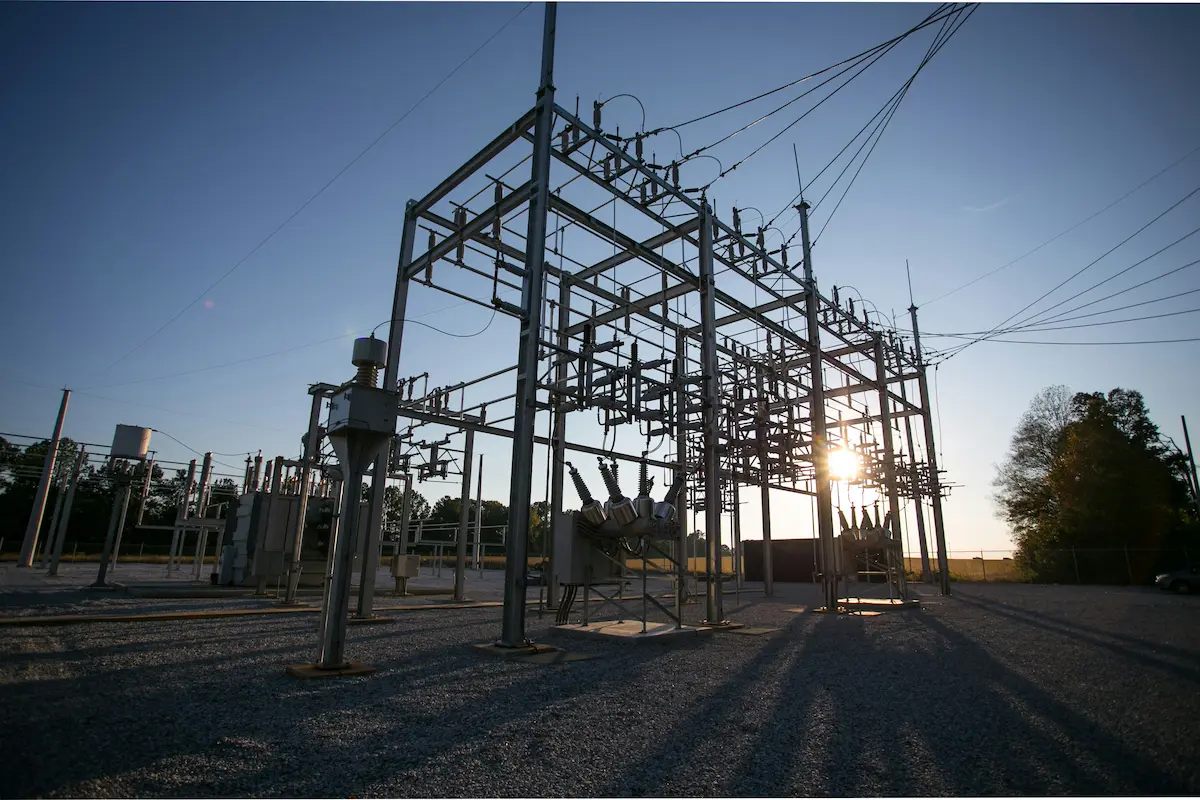
  • Inside the substation that AI is waiting on

    Inside the substation that AI is waiting on

    The switchyard at Aldie sits behind three fences, and the third one is electrified. Inside it, on a Tuesday morning in July, four engineers are deciding what gets connected to the grid this year.

    The decision does not look like a decision. It looks like three people at a folding table with a laptop and a printed one-line diagram, arguing about whether a particular breaker can carry fault current from a source that does not exist yet.

    This film follows that argument for twelve minutes. It is not a documentary about artificial intelligence, though every question in it is downstream of the same buildout. It is about the specific and unglamorous work of connecting one thing to another thing safely, and about the small number of people qualified to do it.

    The engineers agreed to be filmed on the condition that nothing in the footage would identify the specific interconnection under review. Meridian agreed. The technical discussion has been left intact.

    Filmed at a transmission substation in Loudoun County, Virginia, over two days in July 2026.

  • The transformer shortage, in pictures

    The transformer shortage, in pictures

    There are four factories in North America still building large power transformers at scale. Between them they produce fewer units in a year than the continent’s utilities ordered in the first quarter.

    A large power transformer is not a commodity. Each is designed for a specific site, wound to a specific voltage ratio, and tested against a specific set of fault conditions. The copper alone can run to forty tonnes. Once built, the unit is too heavy for most bridges and must be routed by a survey team before it ships.

    These nine photographs were taken over three visits between February and June. They show the winding floor, the vacuum-drying ovens, the test bay where a finished unit is subjected to voltages it will never see in service, and the loading dock where a completed transformer waits for a road permit.

    The lead time on a unit ordered today is between three and four years. In 2019 it was eighteen months.

    Photographs by Sela Amari for Meridian.

  • The court that quietly runs the internet

    The court that quietly runs the internet

    The Western District of Texas hears roughly a third of American patent litigation. Until 2018 it heard almost none.

    The change traces to a single judge and a set of local rules. Judge Alan Albright, appointed in 2018 after a career as a patent litigator, adopted procedures designed to make his court attractive to plaintiffs: fast schedules, a reluctance to stay cases pending administrative review, and a standing order that made transfer motions difficult to win.

    Plaintiffs responded as anyone would. Filings in Waco went from a handful a year to more than eight hundred, and the composition shifted toward entities whose business is licensing rather than making.

    The Federal Circuit has intervened repeatedly, issuing an unusual number of mandamus orders directing transfer. The Judicial Conference adopted a random-assignment policy for patent cases in 2024. Filings dropped, then partially recovered as plaintiffs adjusted.

    What makes this more than a venue story is what it does to product decisions. Companies facing a credible threat in a fast forum settle earlier and design more conservatively around contested claims. Ask a general counsel at a mid-size hardware company what shaped their last roadmap and the honest answer frequently involves a docket in central Texas.

    None of this required legislation, rulemaking or a single appellate holding on the merits. It required one judge with a scheduling order and a plaintiffs’ bar paying attention.

  • What the payrolls revision actually means

    What the payrolls revision actually means

    A benchmark revision is an accounting exercise, not a forecast. Once a year the Bureau of Labor Statistics reconciles its survey-based payroll estimate against unemployment insurance tax records, which cover nearly every employer and arrive with a long lag.

    This year the reconciliation removed 141,000 jobs from the spring. There are three defensible ways to read that.

    The first is that it is noise with a known cause. Benchmark revisions are systematically larger at turning points because the birth-death model that estimates job creation at new firms performs worst when firm formation is changing direction. On this reading the labour market is roughly what it appeared to be and the model will catch up.

    The second is that it confirms a slowdown already visible elsewhere. The household survey has run softer than the establishment survey for three months. Job openings have fallen. Quits are below pre-pandemic norms. The revision, on this reading, resolves a discrepancy in favour of the weaker series.

    The third is more specific and less comfortable: that the revision concentrates in leisure, hospitality and temporary help, and that those categories have historically turned first. Not a slowdown already underway, but the leading edge of one.

    The Fed will most likely take the second reading, because it requires the fewest new assumptions and because it is consistent with the direction officials have been signalling since spring. Whether that is right depends on data that does not exist yet.

  • The museum that collects software

    The museum that collects software

    Preserving a Rembrandt requires controlled humidity, controlled light and a conservator. Preserving a 1994 CD-ROM requires all of that plus a working drive, a compatible operating system, a machine that will boot it, and someone who remembers what the software was supposed to do.

    The Computer History Museum’s software collection runs to roughly 300,000 titles. Fewer than four per cent have been verified as running in an emulated environment.

    The technical obstacles are surmountable and largely solved in principle. Disk images can be captured. Emulators exist for most historically significant platforms. The harder problem is that software is not a document. It is a behaviour, and a behaviour requires an environment — an operating system version, a display mode, a peripheral, sometimes a network service that was decommissioned in 2003.

    Copyright makes the rest of it worse. Most commercially released software from the period remains under copyright, frequently held by entities that no longer exist in any traceable form. The Copyright Office has granted a narrow exemption for preservation, renewed every three years, which permits institutions to circumvent protection for archival purposes but not to make the results available remotely.

    The practical consequence is that a researcher must travel to the collection to use it, which for a category of object that exists as pure information is close to absurd.

    The people doing this work are aware that they are racing hardware. Optical media from the mid-nineties has a documented failure rate rising sharply past thirty years. The drives that read it are no longer manufactured.

  • The shipping lane that moved

    The shipping lane that moved

    Trade routes change slowly and for large reasons: a canal opens, a war closes a strait, a chokepoint silts up. This one changed because underwriters repriced.

    Beginning last autumn, marine insurers raised war-risk premiums on a corridor that had carried a substantial share of Asia-Europe container traffic since the canal’s expansion. The increase was not dramatic on a single voyage. Compounded across a service loop and a fleet, it was enough to make the longer route cheaper.

    Carriers adjusted quietly, as they generally do. Schedules were extended by eight to twelve days. Rotations were redrawn. Two alliances redeployed capacity to absorb the additional sea time, which absorbed the slack that had been keeping spot rates soft.

    The consequences arrive in October. Retail inventory planning for the winter season was set in the spring on the old transit times, and the difference between an eight-day and a twelve-day extension is the difference between a late shipment and a missed season.

    Ports at the far end of the new routing are the other pressure point. Two of them were operating near their practical berth limit before the change and have now absorbed additional calls without additional cranes.

    None of this is a crisis and most of it will be absorbed. It is worth noticing chiefly because of how it happened: no government decided anything, no treaty changed, and a route that had held for a decade moved because a spreadsheet in London said it should.